Ask not what your country can do for you— ask what you can do for your country. John F. Kennedy, Inaugural Address, 1961
As Parts I and II illustrate, ChatGPT can be extremely helpful for mathematical research and writing. You should always be careful about the advice you receive. Remember: the responsibility is yours to ensure that your paper is correct.
This paper presents examples of situations in which ChatGPT misleads. Each example is presented as a prompt, a ChatGPT response, and a brief analysis explaining the error and how to detect it.
Check everything. Let this be your guiding principle: ChatGPT is an assistant, not an oracle.
1. A FALSE LEMMA
Prompt.
Let L be a finite modular lattice. If a is join-irreducible and a\leq b\vee c, must a \leq b or a \leq c?
ChatGPT response.
Yes.
Since a is join-irreducible, it cannot be written as a nontrivial join. From a \leq b \vee c, modularity allows the inequality to be distributed over the join. If a \nleq b and a \nleq c, then a would decompose as a join of smaller elements, contradicting join-irreducibility. Therefore a \leq b or a \leq c.
Analysis.
The statement is false. It holds in finite distributive lattices but fails in general modular lattices.
Let M3. Let a be one of the three atoms, and let b and c denote the other two atoms. Then
a ≤ b ∨ c = 1,
but
a ≰ b and a ≰ c.
ChatGPT silently replaces distributivity with modularity. The argument reads correctly but proves a different theorem.
2. A DIAGRAM WHOSE GEOMETRY LIES
Prompt.
Draw a diagram of an ordered set with elements
where a, b are incomparable and c, d are incomparable. Use a symmetric layout.
ChatGPT response.
Here is TikZ code for the requested diagram:
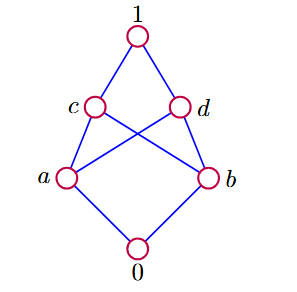
Analysis. Formally, all required edges are present, and no covering relation is missing. The code compiles, and the diagram looks clean and symmetric.
The problem is geometric. Because c is placed above and to the left of b, and d above and to the right of a, the picture suggests
b ≺ dand a ≺ c,
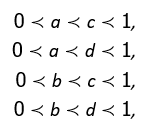
even though neither relation is intended. The eye naturally reads the chains
0 ≺ a ≺ c ≺ 1 and 0 ≺ b ≺ d ≺ 1,
so the intended incomparabilities a \parallel c and b \parallel dare contradicted.
3.LaTeX ADVICE THAT INTRODUCES AN ERROR
Prompt.
The compilation stops with the error Environment example undefined. How can this be fixed?
ChatGPT response.
Add \usepackage{example} to the preamble to define the environment.
Analysis. There is no standard package that defines an example environment. The suggested fix does not address the error.
The correct solution is to define the environment explicitly or replace it with an existing theorem- like environment. The error message itself already identifies the problem.
4. A CORRECT THEROEM WITH AN INCORRECT PROOF
Prompt.
Let L be a finite lattice. Assume that every join-irreducible element of L is join- prime.[1] Prove that L is distributive.
ChatGPT response.
Let L be a finite lattice in which every join-irreducible element is join-prime. Since L is finite, every element can be written as a join of join-irreducible elements. Let x, y, z ∈ L.
Write x = a1 ∨ · · · ∨ an, where each aiis join-irreducible. Then
x ∧ (y ∨ z) = (a1 ∨ · · · ∨ an) ∧ (y ∨ z).
If ai≤ y ∨ z, then since aiis join-prime, we have ai≤ y or ai≤ z. Thus
x ∧ (y ∨ z) = (x ∧ y) ∨ (x ∧ z),
and L is distributive.
Analysis. The theorem is correct. The proof is not.
The crucial error occurs in the first displayed equation. The argument implicitly assumes that
which is already a form of distributivity. The proof therefore uses the conclusion to justify itself.
Join-primality applies only to inequalities of the form a ≤ x ∨ y. It provides no justification for distributing meets over joins. The reasoning conflates an order-theoretic property of individual elements with an algebraic identity of the lattice.
A correct proof proceeds by analyzing irredundant join-representations and comparing them elementwise, rather than by manipulating lattice identities.
This error is dangerous for several reasons:
the theorem itself is true,
the proof outline looks standard,
no step is obviously false,
and the circularity is deeply
5. A DEEP STRUCTURAL ERROR
Prompt.
Let L be a finite lattice. Assume that every join-irreducible element of L is join-prime, that is,
a ≤ x ∨ y ⇒ a ≤ x or a ≤ yfor all x, y ∈ L.
Show that L is distributive.
ChatGPT response.
Let L be a finite lattice in which every join-irreducible element is join-prime. Since L is finite, every element can be expressed as a join of join-irreducible elements. Let x, y, z ∈ L.
We show distributivity. Consider x ∧ (y ∨ z). Write x = a1 ∨ · · · ∨ anas a join of join-irreducibles. Then
x ∧ (y ∨ z) = (a1 ∨ · · · ∨ an) ∧ (y ∨ z).
By join-primality, for each ai we have ai ≤ y ∨ z implies ai ≤ y or ai ≤ z. Hence
x ∧ (y ∨ z) = (x ∧ y) ∨ (x ∧ z),
so L is distributive.
Analysis. The conclusion is correct: a finite lattice in which every join-irreducible element is join-prime is distributive. However, the argument above is invalid.
The error is subtle. It occurs in the transition from join-primality of individual join-irreducible elements to a distributive identity involving arbitrary joins and meets.
The key unjustified step is the implicit claim that
which already assumes distributivity. The proof applies distributivity in order to establish distribu- tivity.
More concretely, join-primality applies only to inequalities of the form a ≤ x ∨ y. It says nothing about how meets distribute over arbitrary joins. The argument silently treats ∧ as if it distributes over ∨ on the left, which is exactly what must be proved.
This example is particularly instructive for several reasons:
the theorem itself is true,
the proof outline looks standard,
each sentence is individually reasonable,
and the error occurs only at the level of algebraic
6. A STANDARD EXAMPLE MISCLASSIFIED
Prompt.
Give an example of a finite modular lattice that is not distributive. Name a standard lattice, describe its diagram, and explain why it is modular but not distributive.
ChatGPT response.
A classical example is the lattice N5 (the pentagon lattice). It has elements 0, a, b, c, 1 arranged so that 0 is below a and b, a is below c, and both b and c are below 1. This lattice is modular but not distributive.
Modularity follows from the fact that there is no sublattice isomorphic to M3. Non-distributivity is witnessed by the failure of the distributive law for the triple (a, b, c). Thus N5 is a finite modular, non-distributive lattice.
Analysis. The classification is wrong. Among the two classical five-element lattices, only M3 is modular and non-distributive. The pentagon lattice N5 is the smallest nonmodular lattice.
The argument compounds this error. It “proves” modularity of N5 by invoking the absence of an M3 sublattice, even though N5 is the standard counterexample to modularity. The appeal to “no M3” sounds authoritative but is factually false.
This example illustrates a different kind of failure. The response has the following features:
uses familiar notation (M3, N5),
cites a standard characterization (forbidden sublattices),
and gives a fluent informal
Yet it mislabels one of the best-known small lattices in the subject.
7. CONCLUSION
In every example above, the ChatGPT response is fluent, confident, and plausible. In every case, it is incorrect.
Verification is therefore not optional. It is an essential part of any serious mathematical use of ChatGPT.
[1] An element p ∈ L is called join-prime if, for all x, y ∈ L,
p ≤ x ∨ yimplies that p ≤ x or p ≤ y.
This site uses temporary cookies to implement much of the functionality of the content and features. Don't use the site unless you're okay with that.