

Cognitive Asceticism and Paradoxes


CSHPM Notes brings scholarly work on the history and philosophy of mathematics to the broader mathematics community. Authors are members of the Canadian Society for History and Philosophy of Mathematics (CSHPM). Comments and suggestions are welcome; they may be directed to the column’s editors:
Amy Ackerberg-Hastings, independent scholar (aackerbe@verizon.net)
Nicolas Fillion, Simon Fraser University (nfillion@sfu.ca)
‘It is a truth universally acknowledged that a single man in possession of a good fortune must be in want of a wife.’ With this generalization Jane Austen begins Pride and Prejudice. The confidence with which she asserts it makes the reader think that she has every justification for it. One might almost call it a social theorem.
In general, literature is not studded with the kinds of statements one finds in mathematics: theorems, corollaries, lemmata, or axioms. There is one exception to this rule, namely, paradoxes. One question is whether paradoxes in literature and elsewhere are of the same kind as those in mathematics. This article aims to make a case that reactions to paradoxes in other genres may be of some use in dealing with certain paradoxes in mathematics.
There is nothing particularly mathematical about the word ‘paradox’. Just as ‘orthodox’ refers to ‘right belief’ and ‘heterodox’ refers to ‘different belief’, so ‘paradox’ refers to ‘beyond belief’ (‘para’ as a prefix has a range of applications). The word is of venerable antiquity, and examples abound even in Greek times. Anthony Gottlieb, for example, refers to the ‘paradoxical’ style of Heraclitus, as exemplified in sayings such as ‘The upward road and the downward road are the same road’ [4, p. 41]. Even better known is the story of Socrates, who was puzzled by the verdict of the oracle at Delphi that he was the wisest of all Greeks. He was aware of how little he knew, but in conversing with others they always seemed to claim more knowledge than they actually possessed.
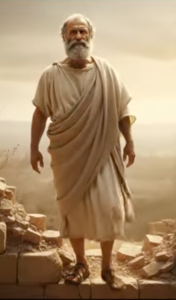
Figure 1. Screenshot of a presumably AI-generated Socrates stating a mistranslation from Apology, 21d. YouTube video by thevoiceofsocrates, 28 November 2025.
There have been periods in English literature during which paradoxes seemed the order of the day. In the late nineteenth century Oscar Wilde and George Bernard Shaw entertained theatre-goers with a wealth of paradox in play after play. Outside drama G.K. Chesterton made much use of the tool in literary criticism and even in theology. More recently, Jorge Luis Borges created entire stories as a paradox, e.g., ‘The Library of Babel’ [2, passim]. One of the popular songs in The Pirates of Penzance, an opera by Gilbert and Sullivan, builds on a paradox connected with birthdays and leap years.
Religion has long had to deal with paradox, and the line attributed to Tertullian (‘Credo quia absurdum’—I believe it because it is absurd) has been part of Christian theology for many centuries. Koans in Buddhist tradition often seem to be nothing but paradoxes. Douglas Hofstadter in his Gödel, Escher, Bach devotes several chapters to koans and their uninterpretability [5]. In Matthew Bagger’s The Uses of Paradox [1], he suggests a way to deal with paradoxes in a religious setting that will come up again at the end of this piece.
Paradoxes in mathematics have had various effects. The consequences of Russell’s paradox (the inability to determine whether the set of all sets that are not members of themselves is a member of itself) for Frege’s project in his Grundgesetze are well known. One can argue that Gödel’s success in pulling down Principia Mathematica was founded on a paradox like the Liar. The Banach-Tarski paradox, by contrast, has not involved rewriting any mathematics. Its conclusion (that one can cut up a ball into a finite number of pieces and then reassemble them to get a ball twice as big as the original ball) runs up against common sense, but then most of us do not have the kind of common sense able to deal with infinitely thin knives. By contrast, the paradox of the Liar continues to generate philosophical responses. Some have argued that the problem with ‘This statement is false’ is its self-referential character, but then versions offered by Quine and Yablo, among others, seem to raise the same problem without the self-reference [6, p. 9; 3, pp. 50–51].
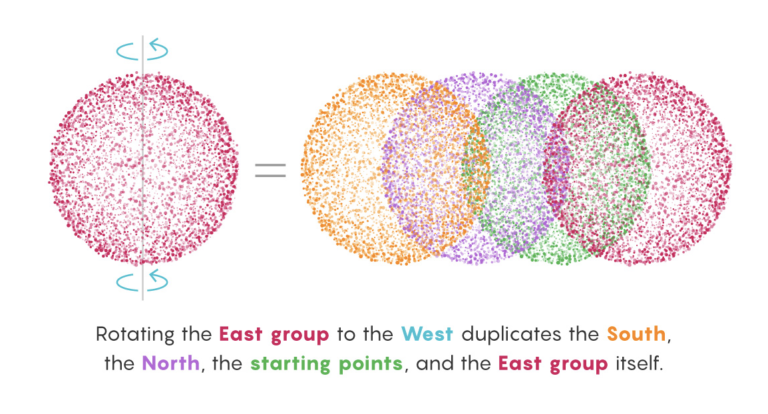
Figure 2. One visualization of the Banach-Tarski paradox. Artwork by Samuel Velasco for Max G. Levy, “Banach-Tarski and the Paradox of Infinite Cloning,” Quanta Magazine, 26 August 2021.
What makes something paradoxical? The collision with common sense usually comes as something of a surprise. There is often some kind of humour in seeing how common sense has to learn to adapt to calculations. Probability offers a number of such paradoxes, such as the birthday problem (it only takes 23 people in a group to make the probability of a shared birthday greater than 1/2) or Simpson’s paradox (what’s true of all subsets individually may no longer hold when they are aggregated).
Perhaps a plausible analogy is the situation with regard to the Continuum Hypothesis. Gödel was able to show that if one added a certain axiom to the standard axioms for set theory, the resulting system was able to show that the Continuum Hypothesis (there is no infinity between the number of whole numbers and the number of reals) is true. Then Paul Cohen demonstrated that if one added a different axiom to the standard axioms, the resulting system was able to show that the Continuum Hypothesis was false. In both cases the additional axioms were shown to be consistent with the standard axioms.
There is a further problem with this conflict that did not arise in the case of Euclidean and non-Euclidean geometries. As pure mathematics they may be equally legitimate, but when they came up against the structure of the universe, non-Euclidean geometry won the contest. There is no obvious universe to serve as an arbiter for the axioms that refer to infinite sets.
In fact, infinity has long been a source of paradoxes—one can put this down to the inability of common sense to handle the infinite. The demonstration that infinite sets can have proper subsets of the same cardinality prevents us from falling back on the Euclidean notion that the whole is greater than the part. Surely there is also something paradoxical about the Löwenheim-Skolem theorems, even if we do not refer to them as paradoxes. They assert, after all, that if a set of axioms has an uncountable model, then it also has a countable model, and if that does not run up against such common sense as we have about the infinite, I do not know what does. The fact that cardinality depends on one’s machinery for finding one-to-one correspondences makes it sound as though the size of a set could depend on the order in which one is tallying members.
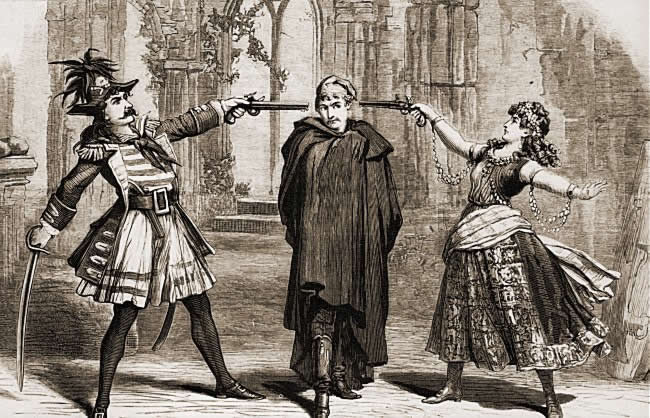
Figure 3. An 1880 drawing of the ‘paradox trio’ from Act II of The Pirates of Penzance, in which the Pirate King and Ruth hold Frederic at gunpoint while they explain the paradox engendered by his February 29 birthday. Commissioned by D’Oyly Carte Opera Company for the opera’s London premiere. Gilbert and Sullivan Archive.
Quantum mechanics has also been a source of paradoxes, and one can argue that it is a source of nothing but paradoxes. The continuing literature on how to interpret the formalism that produces correct predictions suggests that there is no consensus about interpretation, however ready the community of physicists may be to accept the formalism. Hidden variables have been shown not to work, and if it is necessary to alter one’s logic, that has a paradoxical character in its own right.
When one has contemplated certain paradoxes and beaten one’s head against the wall in trying to resolve them, one may be tempted to argue that some paradoxes are not necessarily in need of resolution. That seems to be true of Zen koans, for example, and perhaps riddles like the Mad Hatter’s ‘Why is a raven like a writing-desk?’ It may not be easy to dispose of the nagging suspicion that at least one prong of the paradox must be based on an error in reasoning. There are plausible fallacies that do not yield their faults up on preliminary inspection, such as Kempe’s claim to have proved the Four Colour Theorem in 1879, which was only refuted in 1890.
What Bagger points to as a way out is what he calls ‘cognitive asceticism’ [1, cap. 2]. The term ‘cognitive dissonance’ has been widely applied to the situation of not being able to resolve apparently conflicting statements. Much psychological effort goes into trying to dissolve the dissonance on the assumption that the dissonance itself is a source of tension. What Bagger suggests, specifically in the realm of religion, is a kind of acceptance without feeling that the world is necessarily crashing around one. Some paradoxes are a blow to common sense but allow for a way forward with common sense chastened. When paradoxes apparently lead to a contradiction, it might typically be felt in mathematics that this sort of acceptance is bound to lead to the acceptance of every statement. On the other hand, it may be the case that if one puts up a few roadblocks in one’s logic, then the notion that accepting both sides of a paradoxical conclusion is fatal can be resisted. There are, after all, paraconsistent logics, and it may not be surprising that it is to them that paradoxes lead.
References
[1] Bagger, Matthew C. (2007) The Uses of Paradox. New York: Columbia University Press.
[2] Bloch, William Goldbloom. (2008) The Unimaginable Mathematics of Borges’ Library of Babel. Oxford: Oxford University Press.
[3] Cave, Peter. (2009) This Sentence is False: An Introduction to Philosophical Paradoxes. London: Continuum.
[4] Gottlieb, Anthony. (2000) The Dream of Reason: A History of Western Philosophy from the Greeks to the Renaissance. New York: Norton.
[5] Hofstadter, Douglas. (1979) Gödel, Escher, Bach: An Eternal Golden Braid. New York: Basic Books.
[6] Quine, W. V. (1966) The Ways of Paradox and Other Essays. New York: Random House.
Thomas Drucker is currently chair of the Philosophy of Mathematics Special Interest Group of the Mathematical Association of America. At the 2025 MathFest in Sacramento, he was one of the organizers of a session on paradoxes, in which he also spoke. He retired from teaching at the University of Wisconsin–Whitewater in 2021.


