

A pictorial story


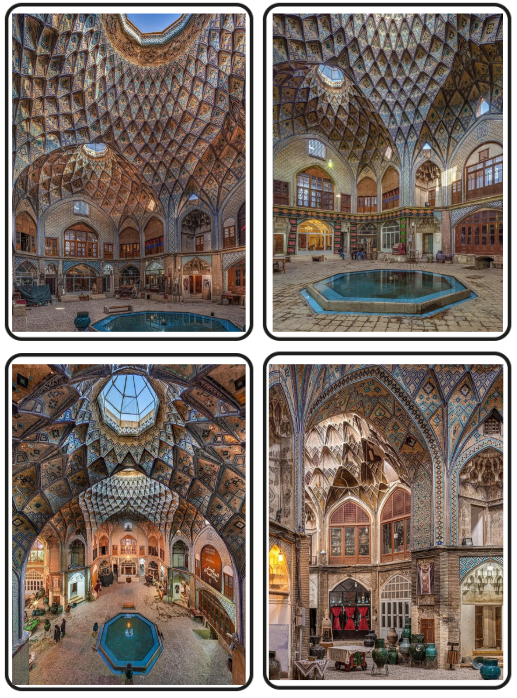
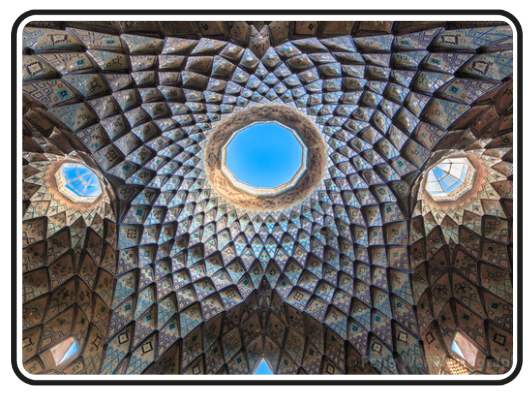
Timcheh Amin od-Dowleh, built in 1868, is one of several traditional plazas within the Grand Bazaar of Kashan, Iran. A timcheh is a specialized commercial space within a bazaar, typically smaller and more intimate than the main market streets, where merchants, craftsmen, and traders could conduct their business.
This building is distinguished by its remarkably high, multi-tiered dome, decorated with intricate stalactite vaulting and geometric brickwork. The symmetrical, two-story structure is organized around an open central courtyard, surrounded by small shops, offices, and commercial spaces. One of its most striking features is the large central skylight at the top of the dome. It allows natural light to penetrate deep into the building, illuminating the central hall and creating constantly changing patterns of light and shadow throughout the day. The combination of height, geometry, brickwork, and natural light gives the space a remarkable sense of scale and tranquility despite its original commercial purpose.
Timcheh was more than simply a collection of shops. It was part of a larger network of workshops, merchants, craftsmen, and traders that sustained the economic and social life of the city. In that sense, the building stands not only as an architectural monument, but also as a reminder of a time when commerce, craftsmanship, and community life were deeply intertwined.
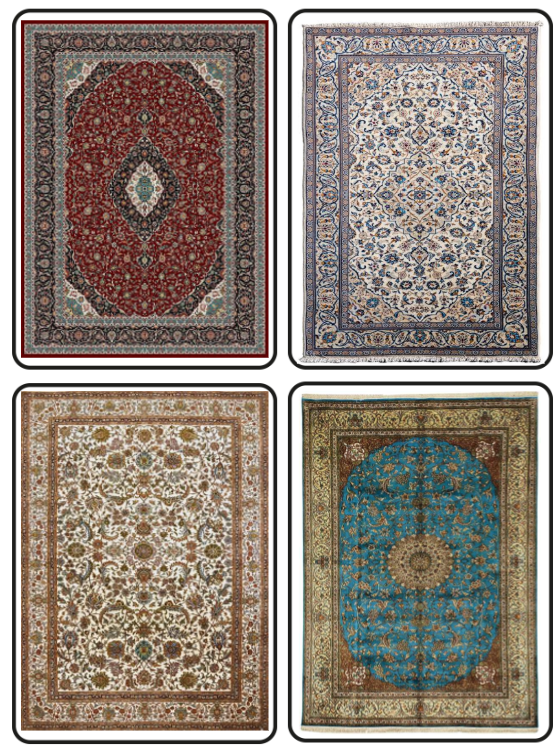
Most traditional carpets feature a high degree of symmetry in their patterns. A particularly common approach is bilateral symmetry, in which the design is mirrored across both the vertical and horizontal axes. This symmetry provides a clear underlying structure that helps organize the many intricate elements of the pattern, from flowers and leaves to geometric motifs and decorative borders.
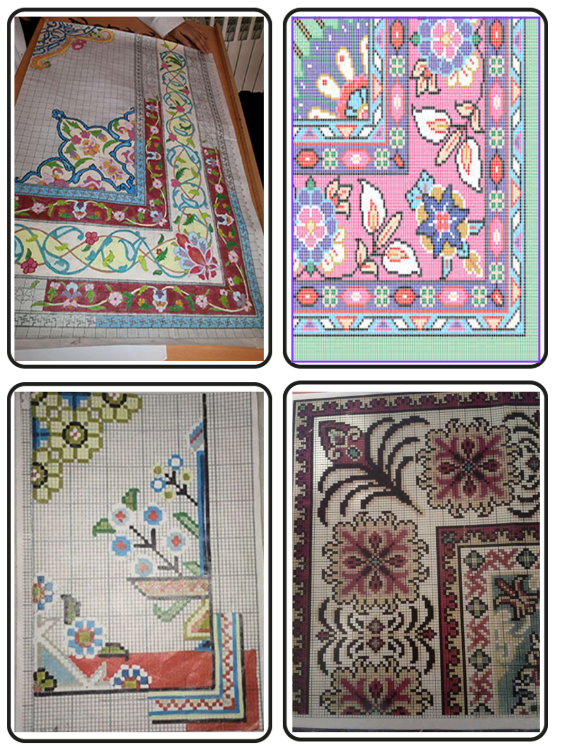
Because of the bilateral symmetry, the designer only needs to draw one quarter of the carpet pattern in full detail. The other three sections can then be created by reflecting this initial quarter across the vertical and horizontal axes. This simple mathematical principle greatly reduces the amount of work required while preserving the precise balance and harmony of the overall design.
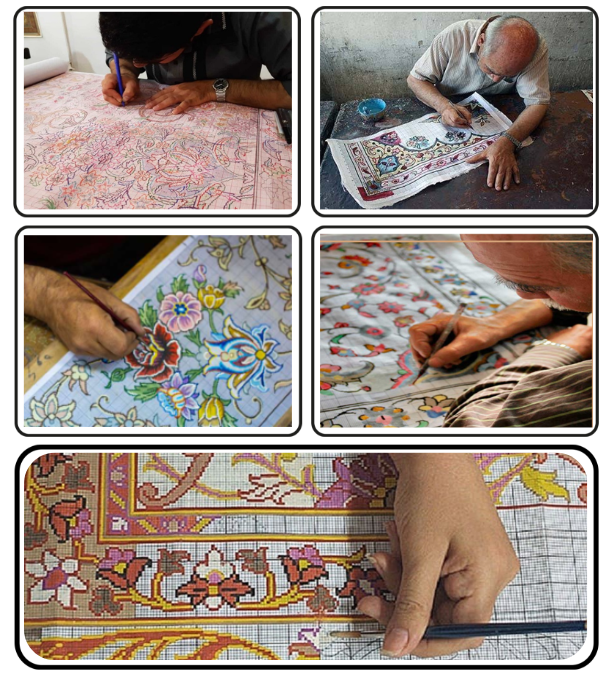
The carpet designer’s work required exceptional precision, patience, and artistic skill. Even a small error in the initial quarter of a pattern would be replicated through the reflections and could become visible across the entire carpet. Traditionally, professional carpet designers spent months developing a new pattern, carefully drawing and painting every detail by hand on gridded design paper, where the small squares provided a precise guide for positioning and reproducing the intricate motifs. Their work combined artistic creativity with remarkable attention to geometric structure, proportion, and symmetry.
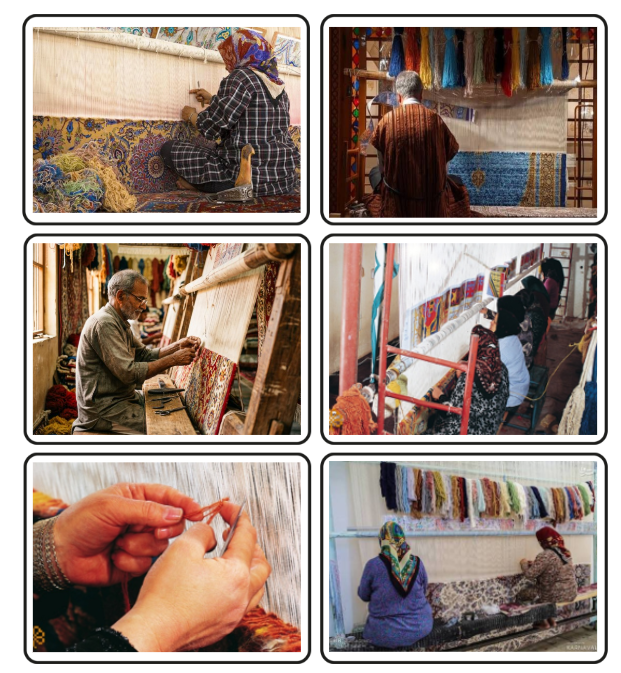
The finished patterns then served as a guide for another group of skilled and hardworking artisans, who used them to weave the carpet according to the design. Depending on the type, size, and complexity of the carpet, the weaving process could take anywhere from several months to several years. A handmade carpet was never the work of a single person. Behind every finished carpet stood many skilled workers, each contributing a specialized part of the process, from designers and pattern makers to dyers, spinners, weavers, trimmers, washers, and finishers. The industry also supported a wide network of other businesses and trades involved in supplying raw materials, preparing and transporting them, selling the finished carpets, and maintaining the tools and equipment needed for their production. For generations, these interconnected occupations formed an important economic and social fabric, allowing entire communities to make their livelihoods through the creation and trade of handmade carpets.
After several centuries of accumulated experience, with knowledge and skills passed down from one generation to the next, this traditional society faced two new realities.
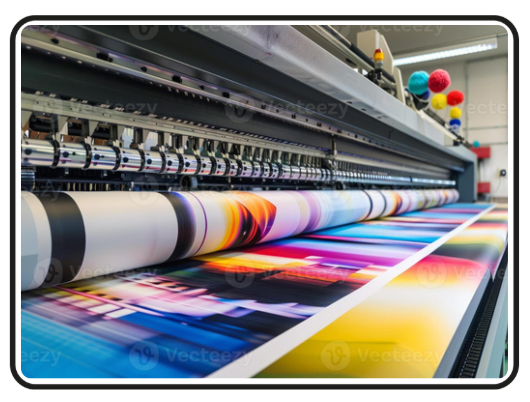
First, the emergence of powerful computers capable of designing and printing intricate carpet patterns in a matter of minutes.
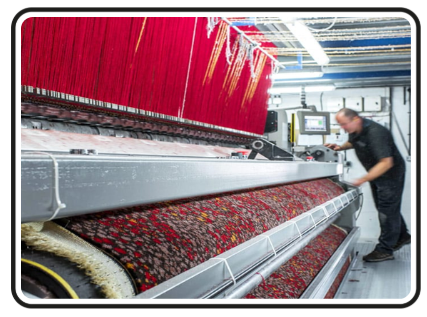
Second, advanced industrial machines could weave carpets in just a few hours, tasks that had once required months or even years of painstaking work.
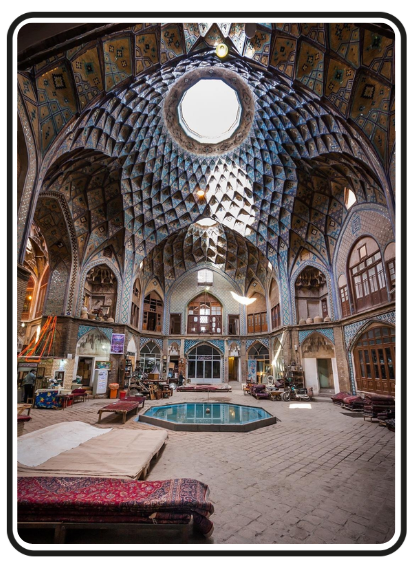
Returning to the initial photographs of Timcheh, the right-side office on the second floor once belonged to my grandfather, who was a carpet designer. When I was in primary school, I used to spend the hot summer months in this plaza. In today’s language, it was somehow our summer camp, a place where I, along with other children, could enjoy all kinds of childhood activities while remaining under the watchful eye of the family elders.
This magnificent building is still standing firmly on the same ground. But the respected people who once worked there are mostly gone now. Their offices have been sold and have, for the most part, been transformed into other businesses. The traditional businesses and crafts that once surrounded the creation and trade of hand-woven carpets are no longer the main activity of the Timcheh.
That said, the city and its bazaar are still very much alive. Technology has transformed the carpet industry in remarkable ways. Computers have opened the door to spectacular new patterns and designs that would have been difficult, if not impossible, to create in the past. Modern industrial machines can now produce carpets of remarkably high quality, with extraordinary speed and precision, while keeping them affordable and accessible to a much broader population. Their efficiency, consistency, and ability to reproduce increasingly sophisticated designs have attracted many families, changing the way people think about carpets and encouraging them to bring these new creations into their homes.
In this sense, modern technology has fundamentally changed the traditional business model. What once required enormous amounts of time, skilled labor, and patience can now be produced on a large scale, with impressive quality and at relatively affordable prices. The carpet has, in many respects, moved from being a labor-intensive household or commercial craft to a highly efficient modern product, capable of reaching a mass market.
Ironically, however, the traditional hand-woven carpet industry has not disappeared altogether. It survives on a smaller scale, sustained by a limited number of highly skilled and dedicated artisans. Some of these rare professionals maintain their own galleries, where they create carpets that are no longer simply regarded as household objects or commercial goods, but as works of art. These exceptional hand-woven carpets may require months or even years of painstaking work and command extraordinarily high prices, affordable only to a very select class of people.
Thus, the transformation is somewhat paradoxical. Modern technology has made beautiful, sophisticated carpets available to ordinary families at prices that would once have seemed unimaginable, while the traditional hand-woven carpet has moved in the opposite direction: from an everyday craft and commercial product toward a form of highly valued artistic expression. The carpet has therefore not simply disappeared with modernization; rather, it has divided into two very different worlds: one defined by technological innovation, mass production, affordability, and accessibility, and the other by craftsmanship, rarity, artistic value, and exclusivity.

With the profound changes brought about by the rapid emergence of AI in mind, it may now be clearer why I chose to tell this story. I see in it a striking parallel to our present concerns about the rapid emergence of AI and its growing presence in our academic departments.
There is little doubt that fundamental changes are already taking place, and that many more lie ahead. Our university campuses will certainly continue to stand for many years to come, and they may even retain structures that look surprisingly familiar. But what will our departments look like? How will our roles evolve? Will we see the emergence of highly specialized and sophisticated research universities, bringing together some of the world’s leading scientists, alongside a growing number of universities increasingly focused on education and teaching rather than cutting-edge research? And what will become of the work, traditions, relationships, and human interactions that give our academic communities their distinctive character today?
P.S. All the photographs in this note were found on the internet and, to the best of our knowledge, none of them was accompanied by a copyright claim.


