

The Classification of Research Mathematics from 1846 to the Present


CSHPM Notes brings scholarly work on the history and philosophy of mathematics to the broader mathematics community. Authors are members of the Canadian Society for History and Philosophy of Mathematics (CSHPM). Comments and suggestions are welcome; they may be directed to the column’s editors:
Amy Ackerberg-Hastings, independent scholar (aackerbe@verizon.net)
Nicolas Fillion, Simon Fraser University (nfillion@sfu.ca)
Two articles nicely illustrate the range of research historians of mathematics are conducting into the history of classification and information retrieval in mathematics: Michael J. Barany’s 2021 “Abstract Relations: Bibliography and the Infra-structures of Modern Mathematics” [1] and Craig Fraser’s 2020 “Mathematics in Library and Review Classification Systems: An Historical Overview” [4]. The present essay provides a synopsis of the part of Fraser’s article that was devoted to a study of the ideas and innovations involved in the classification of mathematical research journals and books. It complements an earlier column in CMS Notes on the library classification of mathematical books [3]. Barany’s article is recommended as follow-up reading for its exploration of the wider social and political aspects of classification of mathematics since the 1920s.
Some Nineteenth-Century Background
As most readers of the Notes know, mathematics—and, indeed, all of intellectual life—changed dramatically throughout the 19th century in Europe. One of these transformations was the maturation of physics into an academic discipline, with the corresponding creation of journals, academic societies, and university departments. The mathematical level and sophistication of work in physics increased substantially as well. During the 18th century major contributors to mathematical physics were also leading mathematicians: Taylor, d’Alembert, Euler, Lagrange, Laplace, and so on. However, by the end of the 19th century the leading contributors to mathematical physics were physicists: Maxwell, Kelvin, Hertz, Weber, Boltzmann, and so on. The situation is aptly summarized by McCormmach and Jungnickel [6, p. 185]: “The position of intermediary between mathematics and physics, as Riemann was seen to hold, was increasingly taken over by a new kind of specialist, the theoretical physicist. The theoretical physicist might consult or even collaborate with a mathematician, but he always worked as a physicist rather than a mathematician.” This state of affairs would have implications for those who attempted to describe the research being done in physics.
Meanwhile, within mathematics itself, growing emphasis was placed on pure mathematics, a development that was connected in the case of Germany with the cultural outlook of neo–humanism (see [8]). Mathematics journals continued to include mechanics and applied topics, but over time applications received a decreasing share of the total content published in these periodicals.
Another change was the emergence of the foundations of mathematics as a field of discussion and investigation. This development was connected to the focus on pure mathematics but was also stimulated by an infusion of interest into formal logic. Traditionally, mathematics had been distinguished from the language fields of logic, rhetoric, and grammar, a distinction that was built into the structure of both the liberal arts curriculum and Enlightenment conceptions of knowledge. The emergence of formal logical systems provided a language to explore subjects in mathematics. In the philosophy of mathematics, a key work was Gottlob Frege’s 1884 Die Grundlagen der Arithmetik (Foundations of Arithmetic). Frege reasoned that the basis of number in language conferred upon arithmetic an objectivity that was independent of physical considerations. It should be noted that the consolidation of foundations into a field of mathematical research did not occur immediately; rather, it was a development that only achieved full expression in the 20th century. (For more details on the subject of this section see [2].)
Describing an Expanded Discipline
The remarkable growth of mathematics in the 19th century gave rise to a genre of writing devoted to surveys of the state of work in various subjects of interest. For example, reports delivered at the annual meetings of the British Association for the Advancement of Science (BAAS) provided information about current explorations, such as Arthur Cayley’s “Report on the recent progress of theoretical dynamics,” which was presented in 1847 to the BAAS meeting in Dublin and published in the following year. Cayley outlined in some detail developments since 1800 involving Hamilton-Jacobi theory and the theory of canonical transformations. In 1861 Isaac Todhunter published his A History of the Progress of the Calculus of Variations during the Nineteenth Century. The word “progress” in the title indicated that the book covered work up to the time of publication and thus was as much a literature review as it was a history.
At the same time, mathematics journals demonstrated a consistency in their approaches to organizing mathematical knowledge. The general conception was outlined by Auguste Comte and André-Marie Ampère early in the 19th century. Their views were reflected in the table of contents of the inaugural publication in 1836 of Journal für die reine und angewandte Mathematik (Journal for Pure and Applied Mathematics, also known as Crelle’s journal after its principal editor Leopold Crelle). The table of contents consisted of two parts: pure mathematics, encompassing analysis, geometry, and mechanics; and applied mathematics, containing parts of physics such as machines, optics, astronomy, and so on. Analysis itself was made up of arithmetic, algebra, and calculus-related parts of mathematics.
In 1871 two Berlin gymnasium teachers of mathematics, Carl Ohrtmann and Felix Müller, founded the reviewing periodical Jahrbuch über die Fortschritte (Yearbook on the Progress of Mathematics) der Mathematik. The Jahrbuch was modelled after an abstracting journal for physics that had been in existence for close to 25 years, the Fortschritte der Physik (Progress in Physics). Although the publications reviewed in the Jahrbuch consisted mainly of periodical literature, books were also included. The general organization of mathematics in the Jahrbuch reflected the subject organization of prominent research journals such as Crelle’s journal. This subject ordering, arithmetic–algebra–analysis–geometry, differed from the one widely in place in library book classification, which used the more traditional ordering of arithmetic–algebra–geometry–calculus. That the most abstract and abstruse areas of higher analysis were placed before elementary Euclidean geometry reflected a “modern” orientation of mathematics that has remained in place since the second half of the 19th century. (The place of abstract structural mathematics and subject organization is examined by Barany in [1].)
Zentralblatt and Mathematical Reviews
Over the years, a substantial delay developed between the publication of articles and books and the appearance of their reviews in the Jahrbuch. By the late 1920s, this delay had grown to around seven years. In 1931, Göttingen mathematicians Otto Neugebauer and Richard Courant founded the Zentralblatt für Mathematik und ihre Grenzgebiete (Journal of Mathematics and Related Fields) to achieve a timelier review of the mathematical literature. The first editor of the Zentralblatt was Neugebauer, who retained this position until 1938, when he resigned and joined the exodus of scientists from Hitler’s Germany to the United States.
On his arrival in America, Neugebauer became a professor at Brown University in Providence, Rhode Island, where, in 1940, the abstracting periodical Mathematical Reviews (hereafter MR) came into existence (on the early history of MR, as well as developments to the 1980s, see [7]). The rise of the United States as a scientific center and the sheer size of the anglophone mathematics community in the United States and the British Commonwealth made the creation of MR a natural step. The influence of Nazi policies on the operation of Zentralblatt was also a factor. Neugebauer and the Russian-American analyst Jacob Tamarkin became the first editors of the journal. In 1965, MR moved to Ann Arbor, Michigan (adjacent to the University of Michigan), where it remains to this day.
The subject organization of the Jahrbuch, Zentralblatt, and MR was similar, as is seen in the table of contents from the initial issue of each journal given in Table 1.
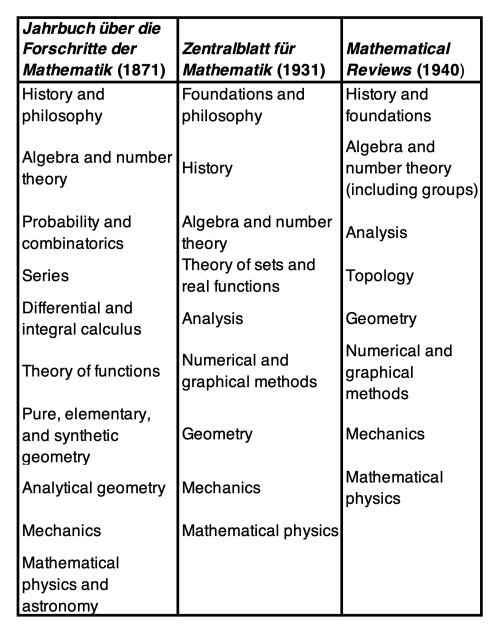
Table 1. The subject classification adopted by MR in 1940 was somewhat more detailed than the schematic overview presented above. The full table of the contents set forth for the first issue in 1940 of MR is given in Figure 1.
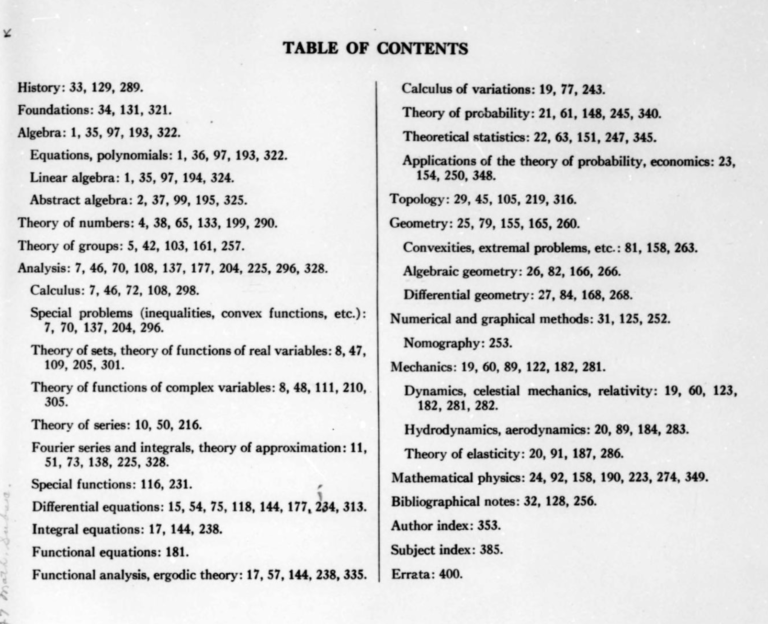
Figure 1. Mathematical Reviews Table of Contents for Volume 1, as shown in the Internet Archive. The complete first number from January 1940 is also available for perusal.
The Mathematical Subject Classification (MSC) System
Over the first two decades of its existence the subject index volumes for MR were organized according to the subject areas listed in the table of contents of each issue. However, in contrast to the ordering in the table of contents, the index ordering was alphabetical; all subclasses were also listed alphabetically. In 1960 a system of codes was introduced in the index, in which the subject areas as listed in the table of contents were given two-digit numbers selected from 02 to 99. Before volume year 1959, all subjects in the index were listed alphabetically. By contrast, the index for 1959 listed subjects by their place in the table of contents in terms of these numerically increasing two-digit codes, according to some conception of the natural relationships that existed among these subjects.
The introduction in 1970 of the Mathematics Subject Classification (MSC) was not motivated by any particular interest in classifying the contents of MR. A reader of an issue of MR could simply consult the table of contents and go to the subject section corresponding to their area of mathematical interest. Rather, it was in order to efficiently process requests for offprints or titles that it proved useful to have a formal system of classificatory codes. The impetus to develop the MSC thus came in the late 1960s from the AMS’s Mathematical Offprint Service (MOS) and its successor, the Mathematical Title Service (MTS).
In the 1970 MSC scheme, the number of classes and sub-classes increased from 900 to 1,900. The scheme maintained the subject whole numbers, but it added a letter of the alphabet to indicate a class. Further topic divisions within this class were indicated by a two-digit number. For example, representation theory of symmetric groups now received the code 20C30. Here 20—as before—was the subject area of group theory, C indicated representation theory of finite groups, and 30 was for representation of symmetric groups.
Two-digit MSC codes appeared for the first time in the table of contents of the issues of MR for 1977. They also appeared beside each subject heading and at the top of every page. During this period, three-digit codes (two-digit subject number and class letter) were employed in the AMS’s periodical Current Mathematical Publications. In 1980, two-digit subject codes were provided for each review in regular issues of MR and became a more integral part of the journal. By the 1990s, every review in MR was accompanied by its full five-symbol MSC code, according to the latest version of the MSC at the time of publication.
The Arrival of MathSciNet and zbMath
The online version of MR, MathSciNet, was established in 1996. It has since replaced the printed edition, which was discontinued in 2012. (For technical matters related to the creation of MathSciNet and the platform for its application see [5].) From the founding of MR to the advent of MathSciNet, shifts in classification have occurred. The policy of MathSciNet is “historical,” meaning that it designates the code that was in place at the time the abstracted item was published (for items published before 1960, the 1960 numerical codes are given). We consider here the example of set theory. In the 1940s and early 1950s, set theory was included in the subject heading “Theory of sets, theory of functions of a real variable” and in MathSciNet publications from this time period are assigned the code 27.2. In the 1950s set theory was put under “Foundations” and in MathSciNet these works are classified with the code 02, which was introduced in 1960 for foundations. Between 1959 and 1999 set theory received its own subject heading and thus in MathSciNet is given the 1960 code 04.
In MSC2000, mathematical logic and foundations were given the code 03; 02 and 04 were abolished; and set theory was returned to logic and foundations and assigned the code 03E. For instance, in MathSciNet, Abraham A. Fraenkel’s Einleitung in die Mengenlehre (Introduction to Set Theory, 1946) is given the code 27.2, Abraham A. Fraenkel and Yehoshua Bar-Hillel’s Foundations of Set Theory (1958) has the code 02, Nicolas Bourbaki’s Elements of Mathematics: Theory of Sets (1968) has the code 04, and John P. Burgess’s Set Theory (2001) has the code 03E, the latter being the subject code for set theory in MSC2000 and the current code for set theory in MathSciNet.
Similarly, the journal Zentralblatt has been replaced by the electronic reviewing service zbMath. For several decades, the agencies MathSciNet and zbMath have worked together in revising the MSC classification system [7]. Major revisions occurred in 1991, 2000, 2010, and 2020. As more book literature appears only in electronic form, the traditional call number classification systems of the Library of Congress and Dewey Decimal will decrease in importance. Instead, the MSC has moved beyond its initial utility in title-retrieval to become the dominant system worldwide today for classifying mathematics.
References
[1] Barany, Michael J. (2021) Abstract Relations: Bibliography and the Infra–structures of Modern Mathematics. Synthese 198 (Suppl 26), S6277–S6290. The supplement is titled “Enabling Mathematical Cultures.”
[2] Fraser, Craig. (2002) Mathematics. In The History of Modern Science and Mathematics, edited by Brian S. Baigrie, i:305–327. Charles Scribner’s Sons.
[3] Fraser, Craig. (2017) Mathematics in Library Subject Classification Systems. In Research in History and Philosophy of Mathematics: The CSHPM 2016 Annual Meeting in Calgary, Alberta, edited by Maria Zack and Dirk Schlimm, 181–197. Cham, Switzerland: Springer International Publishing.
[4] Fraser, Craig. (2020) Mathematics in Library and Review Classification Systems: An Historical Overview. Knowledge Organization 47, 334–356.
[5] Gala, Lauren, Jeffra Diane Bussmann, and Anya C. Bartelmann. (2019) MathSciNet: A Comparative Analysis of American Mathematical Society and EBSCO Platforms. Journal of Electronic Resources Librarianship 31, 1–13.
[6] Jungnickel, Christa, and Russell McCormmach. (1986) Intellectual Mastery of Nature. Theoretical Physics from Ohm to Einstein, Volume 1: The Torch of Mathematics, 1800 to 1870. Chicago: University of Chicago Press.
[7] Pitcher, Everett. (1988) Mathematical Reviews. In Pitcher’s A History of the Second Fifty Years, American Mathematical Society, 1939–1988, 69–89. American Mathematical Society Centennial Publications, Vol. 1. Providence, RI: American Mathematical Society.
[8] Pyenson, Lewis. (1983) Neohumanism and the Persistence of Pure Mathematics in Wilhelmian Germany. Memoirs of the American Philosophical Society, Vol. 150. Philadelphia: American Philosophical Society.
Craig Fraser is professor emeritus at the Institute for the History and Philosophy of Science and Technology of the University of Toronto. His work on the history of mathematics and astronomy from the early 1980s to the present (including the three publications listed in the references above) can be accessed at https://cfraser.artsci.utoronto.ca/publications.htm.


