

Cohorts and Communities in the Algebra Project


CSHPM Notes brings scholarly work on the history and philosophy of mathematics to the broader mathematics community. Authors are members of the Canadian Society for History and Philosophy of Mathematics (CSHPM). Comments and suggestions are welcome; they may be directed to the column’s editors:
Amy Ackerberg-Hastings, independent scholar (aackerbe@verizon.net)
Nicolas Fillion, Simon Fraser University (nfillion@sfu.ca)
On May 22, 2024, the New York Times ran a story by Troy Closson, “The Algebra Problem: How Middle School Math Became a National Flashpoint,” which began with the lines: “Top students can benefit greatly by being offered the subject early. But many districts offer few Black and Latino eighth graders a chance to study it” [1]. The article called readers’ attention to perennial problems the US has with unequal access to algebra for adolescents, but it did not offer solutions. In contrast, the Algebra Project is an ingenious solution that has been around for more than four decades. A shout-out to its founder, Bob Moses, was pinned as the top comment out of thousands that were posted in the first 24 hours after the story was published. But, for this NYT reader who has researched the Project’s history and pedagogical significance, it was dismaying to read how many commenters assumed that Moses probably retired when he became an older man and that the Algebra Project likely died with him—neither assumption could be further from the truth. Moses worked tirelessly his entire life, and the Algebra Project continues to raise the floor of mathematical literacy in locations across the US. This short essay introduces CMS Notes readers to Moses, the historical figure, and the Algebra Project, an ongoing endeavor, by focusing on two themes, cohorts and communities.
Robert P. “Bob” Moses (1935–2021) was a US Civil Rights activist who, in the 1960s, helped organize the Mississippi Freedom Democratic Party and encouraged voter registration. In 2001, Moses co-authored Radical Equations: Civil Rights from Mississippi to the Algebra Project with Charles E. Cobb, Jr. (Figure 1). This book tells the story of how the Algebra Project came into being as part of Moses’s continued commitment to the cause of Civil Rights: “I know how strange it can sound to say that math literacy—and algebra in particular—is the key to the future of disenfranchised communities, but that’s what I think, and believe with all of my heart” [4, p. 5]. Two strands of argument supported this conviction, one that looked back to the tradition of grassroots organizing Moses practiced as a field secretary for the Student Non-violent Coordinating Committee (SNCC), and another strand that looked forward to the future of work in the information age. Looking back, Moses noted that past efforts of Freedom Fighters got Jim Crow out of the vote, the Democratic party, and public accommodations, but they did not get Jim Crow out of the public schools that continued to offer “sharecropper” educations to too many young people. He concluded that ensuring all students have a quality education is part of the unfinished business of the Civil Rights movement.
Looking forward, Moses noted that the rise of information technology had created an unprecedented need for mathematics literacy: “People who don’t have it are like the people who couldn’t read and write in the industrial age” [4, p. 14; see also p. 116]. To be successful in today’s economy, one must understand the tools used to organize information and to communicate quantitative data if one wants to compete for the best jobs and have some say in how society is organized: “The Algebra Project is not about simply transferring a body of knowledge to children. It is about using that knowledge as a tool to a much larger end” [4, p. 15]. Students in Algebra Project classrooms not only learn to read, write, and reason with the formal symbols of mathematics, but also learn how to communicate their ideas and intuitions and cultivate consensus around the shared mathematical features of lived experience [5].
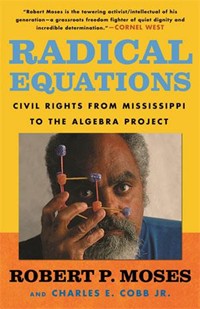
Figure 1. Cover of Radical Equations (2001). Beacon Press.
Algebra Project pedagogy involves a Five-Step Curricular Process that intersects with a three-phase classroom work cycle [7; Figure 2]. The work cycle begins with individual reflection, followed by small group work, followed by whole class discussion. The 5-Step Curricular Process starts with (1) a shared physical experience, followed by (2) individual representations of that experience. These individual reflections are then (3) shared in small groups using ordinary language. The small group’s efforts are (4) communicated to the class using more formal languages, or “Feature Talk.” Feature Talk is an intermediary between the ordinary languages students speak and the symbolic languages mathematicians and scientists use to communicate ideas. Equations and other formal expressions are not direct translations of ordinary language expressions but instead represent a structured discourse designed to minimize ambiguity and maximize consensus: “This ‘regimented discourse’ is the conceptual language that underlies all the various symbolic representations you find in the sciences and mathematics” [4, p. 97].
In the final step in the curricular process, Feature Talk expressions—which can become quite cumbersome in their specificity—are (5) translated into mathematical symbols to achieve a greater economy of expression. Algebra Project pedagogy has many advantages. For one, students learn that the same mathematical idea can be conveyed in more than one way: in ordinary languages, artificial languages, and formal symbols. For another, abstract systems of signification make more sense when students have grounding metaphors to call upon when cultivating their mathematical intuitions. Further, students acquire insight into the historical development of mathematics over time as a creative and collaborative endeavor [6]. But these pedagogical gains are far from the whole story of the Algebra Project: “It’s important to make it clear that even the development of some sterling new curriculum—a real breakthrough—would not make us happy if it did not deeply and seriously address the issue of access to literacy for everyone” [4, p. 15].
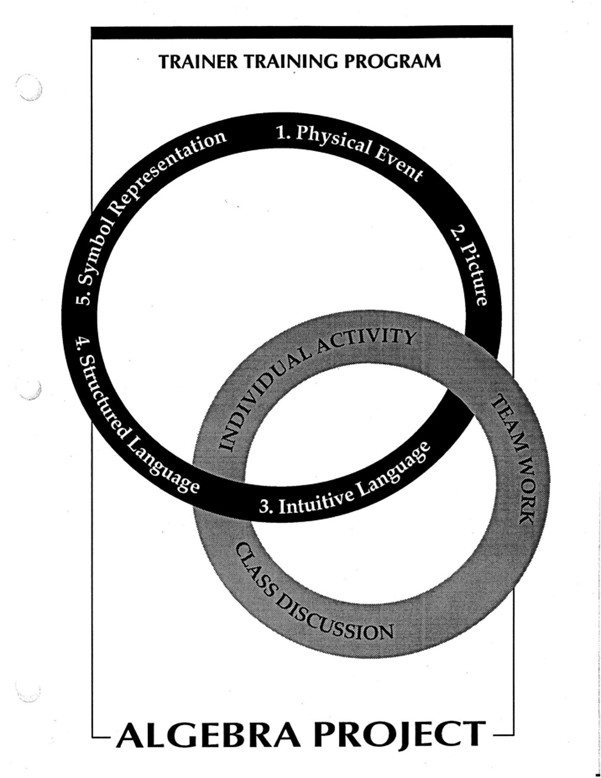
Figure 2. 1992 diagram of the reciprocal mutually-supporting framework of the Algebra Project’s Work Cycle and Five-Step Curricular Process. The Algebra Project Blog, December 22, 2025.
For Moses, mathematics education was a political organizing strategy: “Math is a tool for organizing around the issue of access in the economic arena” [4, p. 136]. Initially, in the 1980s, the Algebra Project targeted middle school mathematics as a site to help students learn the fundamentals of basic algebra. In the 1990s, the Algebra Project expanded to consider how to organize classes so that high school students most at risk could not only pass four years of math but also graduate high school ready for post-secondary educational opportunities. For the project to take root, communities of students, parents, and educators had to take seriously the prospect that all students—even those who currently score in the bottom quartile on mathematics tests—can graduate high school ready to take college-level mathematics. This prospect can be a tough sell: “All parents thought their child should do algebra, but not all parents thought that every child should do algebra” [4, p. 98]. The question comes up: Aren’t there some young people who cannot learn algebra? Moses countered this question by noting that students need two things to be able to learn algebra: they must be able to count, and they must be able to focus on what is happening in the classroom. Of the two desiderata, the former is easier to pull off than the latter. The Algebra Project seeks to demystify mathematics as something only a few gifted people can do well and replace that exclusionary image of mathematics with a more inclusive picture wherein everyone who can count can do mathematics well if they are given quality learning opportunities.
What do quality learning opportunities look like? One difference between the education researcher and the community organizer is, “The organizer does not have the complete answer in advance. . . . The organizer wants to construct a solution with the community” [4, p. 112]. Moses helped organize a program in which the same students would take math together as a cohort for a double-period every day. As he wrote in 2009, “With funding from the National Science Foundation, the Algebra Project works within individual classrooms, where we get students to agree to do ninety minutes of math with us every day for four years of high school. They work to catch up their deficits and jump through the country’s three hoops: the state hoop, the ACT/SAT hoop, and the university hoop” (Moses 2009, p. 379). Students in four out of five cohorts in a multi-site study graduated in higher numbers compared to comparable controls [2; Figure 3]. In addition to developing mathematical proficiency, students formed lasting bonds with peers and instructors. These cohorts made mutual accountability and moral support possible for everyone in the mathematics classroom and created a supportive context for student achievements [8].
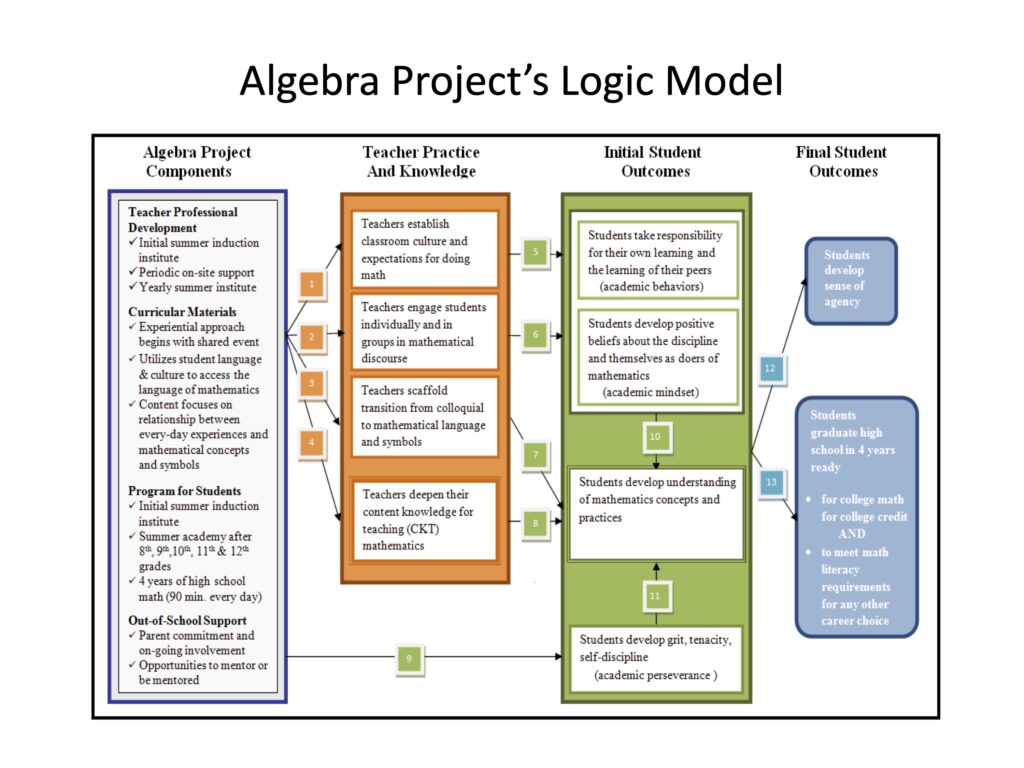
Figure 3. 2014 diagram showing the Algebra Project’s Logic Model. Product Efficacy Argument for “The Development of Student Cohorts for the Enhancement of Mathematical Literacy in Under Served Populations,” NSF Grant DRL-0822175 Final Report, November 30, 2014, p. 4.
What role can communities play in supporting innovative and inclusive education initiatives? One of the most important things we can do is begin to see mathematics, not as something some people do with some parts of their brains, but as something everyone does with their entire being as social and symbolic creatures. Mathematics owes its status as the unifying language of the sciences to its clarity and capacity to generate consensus about the mathematical features of our shared experiences. As Moses argued, if we want to raise the floor of mathematical literacy for the 21st century, we need to see all young people as mathematical beings capable of learning to read, write, and reason with the languages of mathematics: “I think everyone agrees that if it is possible to open the door to real mathematics understanding, it would be a good thing. If we can do it, then we should” [4, p. 111].
References
[1] Closson, Troy. (2024). “The Algebra Problem: How Middle School Math Became a National Flashpoint.” New York Times. May 22, 2024, Section A, p. 1. https://www.nytimes.com/2024/05/22/nyregion/middle-school-math-algebra.html
[2] Educational Testing Service. (2014). Product Efficacy Argument for The Development of Student Cohorts for the Enhancement of Mathematics Literacy in Underserved Populations, by the Algebra Project, Inc. NSF Grant DRL-0822175 Final Report. https://algebra.org//wp-content/uploads/2024/03/HighSchoolCohortsFinalReport-AP2014.pdf.
[3] Moses, Robert P. (2009, Summer). An Earned Insurgency: Quality Education as a Constitutional Right. Harvard Educational Review 79(2), 370–381.
[4] Moses, Robert P., and Charles E. Cobb, Jr. (2001). Radical Equations: Civil Rights from Mississippi to the Algebra Project. Boston: Beacon.
[5] Moynihan, Ben et al. (2026). The Algebra Project Inc. https://algebra.org.
[6] Muntersbjorn, Madeline. (2023). The Algebra Project, Feature Talk, and the History of Mathematics. In Research in History and Philosophy of Mathematics: The CSHPM 2021 Volume, edited by Maria Zack and David Waszek, 261–275. Annals of the Canadian Society for History and Philosophy of Mathematics. Cham, Switzerland: Springer Nature.
[7] Soguero, Aidan, and Bill Crombie. (2024, October 9). The Algebra Project Work Cycle. The Algebra Project Inc. https://algebra.org/2024/10/09/the-algebra-project-work-cycle/.
[8] West, Mary M. (2016, January 30). The Algebra Project: Overview of Research & Evaluation, 1991–2015. https://iris.siue.edu/math-literacy-archive/files/original/82b7ceef4d303db77a55e7b34e9b6412.pdf.
Madeline Muntersbjorn teaches logic and philosophy of science at the University of Toledo in northwest Ohio, US. She is currently co-editing a book of interviews and essays, Bob Moses: Lecture and Legacies, with Greg Budzban and Maisha Moses for the University of North Carolina Press.


